
The Bitcoin Standard Explains Bitcoin. My Book Explains Why It Matters

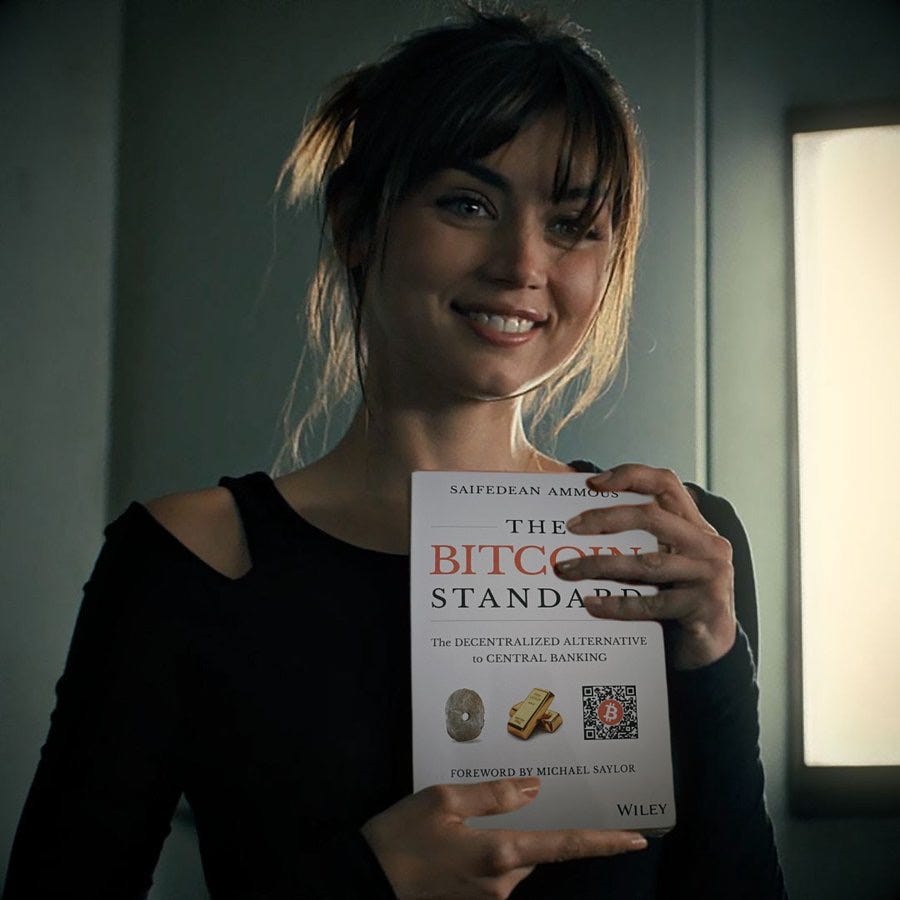
Most of my followers have read The Bitcoin Standard or at least absorbed its ideas. It explains why hard money matters, why fiat collapses, and why Bitcoin solves a multi century problem. It is the economic case, and it is solid.
My upcoming book Birth of Bitcoin is not another tedious recounting of cryptographic protocols or libertarian wish fulfillment. This is something far more dangerous and far more necessary: a work that understands Bitcoin not merely as a technology, but as an act of profound rebellion against the oldest and most entrenched form of human parasitism the debasement of money.
For over five thousand years, from the temples of ancient Babylon to the gleaming towers of central banking, humanity has been enslaved by those who control the creation and distribution of money. The scam is always the same, only the sophistication of the propaganda changes. Create money from nothing, lend it at interest, and watch as the productive capacity of civilization is siphoned into the hands of those who produce nothing but claim everything. Whether you call this force Moloch, as the ancients did, or “monetary policy,” as modern economists prefer, the mechanics remain identical: the systematic transfer of wealth from those who create value to those who manipulate its measurement.
This is why the 2008 financial crisis was not an aberration but a revelation. The system didn’t break down; it revealed itself. When the money printers at the Federal Reserve conjured trillions of dollars to rescue the very banks whose reckless lending had destroyed countless lives, they weren’t fixing a problem they were demonstrating the true nature of fiat currency. Money is whatever those in power say it is, and its primary function is to preserve their power.
Enter Satoshi Nakamoto.
Bitcoin’s creation was not simply a technical innovation but a metaphysical act of defiance. For the first time in human history, someone created a form of money that cannot be debased, cannot be inflated, cannot be controlled by any government, corporation, or priest class. The 21 million limit isn’t just a number it’s a declaration of war against every parasitic institution that has built its empire on monetary manipulation.
The genius of my book lies in its willingness to confront what polite society prefers to ignore: that the battle over money is ultimately a spiritual battle. The ancient priesthoods understood this. They didn’t sacrifice children to Moloch because they were cartoonishly evil they did it because they understood that power requires ritual, that control requires belief, and that the most effective way to maintain both is to make people complicit in their own subjugation. Every time you accept inflationary currency, every time you store your wealth in a depreciating medium, you are making a blood sacrifice to this system.
Bitcoin breaks the ritual.
The story also faces what many people prefer to ignore. Every inflationary system makes you participate in your own loss. Every time value bleeds out of your savings you are carrying the cost of someone else’s power. Bitcoin breaks that pattern by refusing to let anyone touch its supply.
Bitcoin Standard by Saifedean Ammous explains Bitcoin through the lens of Austrian economics, demonstrating why hard money is essential for human flourishing, why low time preference enables civilization, why the inevitable result of easy money is societal collapse. These arguments are sound, but they often fail to capture the visceral truth that Bitcoin’s most ardent advocates intuitively grasp: this is about freedom at the most fundamental level.
By framing Bitcoin’s creation as a thriller, by literalizing the metaphorical demons that haunt our financial system, I have done something that dry economic analysis cannot. I have made the stakes emotionally legible. When you read about Satoshi hunted by forces that will sacrifice anything to maintain their monopoly on money creation, you’re not reading fantasy. You’re reading allegory that gets closer to the truth than most nonfiction ever could.
The parallels to our present moment are impossible to ignore. As I write this, central banks worldwide are racing to implement Central Bank Digital Currencies programmable money that will give governments unprecedented control over every transaction their citizens make. They call it innovation. It is the opposite. It is the ultimate realization of the Babylonian temple system: total surveillance, total control, and the ability to literally turn off your access to the monetary system if you displease the priests.
This is why Bitcoin matters. This is why Satoshi had to disappear. As long as Bitcoin has a leader, it can be coopted, regulated, controlled. By vanishing, Satoshi transformed Bitcoin from a project into a protocol, from a company into an idea that cannot be killed because it has no throat to cut. The epilogue of this book Satoshi destroying his computer and walking away captures the profundity of this sacrifice better than anything I’ve read.
Some will object that this book takes liberties with the facts, that we don’t know the real identity of Satoshi Nakamoto, that the mystical elements are pure fiction. To these objections I say: so what? The literal facts matter far less than the essential truth. Whether or not there was actually a cult hunting Satoshi is irrelevant. The metaphorical truth is undeniable powerful forces would prefer Bitcoin did not exist, and they will do everything in their power to prevent its adoption or, failing that, to control it.
The question we must all ask ourselves is simple: will we continue feeding Moloch, or will we starve him?
Bitcoin offers humanity an escape hatch from five millennia of monetary subjugation. It offers us the possibility of a world where our productivity belongs to us, where our savings cannot be confiscated through inflation, where we can transact without permission from parasitic intermediaries. But Bitcoin succeeds only if enough people choose to use it, to hold it, to build on it.
This book is not entertainment, though it is entertaining. It is not history, though it captures historical truth. It is a call to action disguised as a story, a manifesto wrapped in a thriller. My book is a mythic narrative for a technology that desperately needed one not because Bitcoin requires mythology to function, but because humans require stories to understand why things matter.
I wrote this because Bitcoin is not only an innovation. It is a fight.
And sometimes a story can show that more clearly than a chart.
Read this book. Then buy Bitcoin. Then refuse to sell it for depreciating fiat currency. And when your friends ask why you’re so obsessed with this “internet money,” don’t burden them with explanations of proof-of-work or the Byzantine Generals Problem. Tell them to read this book. Sometimes fiction communicates truth more effectively than facts ever could.
The priests of the financial system will tell you Bitcoin is too volatile, too complicated, too risky. What they mean is: Bitcoin is too free. They’ve built their empires on monetary manipulation, and Bitcoin threatens to topple them all. Good. Let it.
The birth of Bitcoin was not the birth of a technology. It was the birth of hope that humanity might finally break free from the oldest chains of all those forged by the people who control what we call money.
Satoshi gave us the tools. Now it’s up to us whether we use them.
My book releases on Jan 3, 2026.
Read the Bitcoin Standard but I don’t think it is the best Book to understand Bitcoin or even to Orange pill people. Its too much for Joe Average. In german there are some better ones, in English I think Saylor delivered great on explaining Bitcoin with that Tucker Carlson Interview Back in 21 I think. That was awesome!
What do you think?
You’re telling him his baby’s ugly, lol